Thursday, February 4, 2016

Life of a cellphone: Short bursts of freedom


          Normally, your loyal blogger challenges himself to write without using the word ‘I.’


          Most bloggers, it says here, have an ‘I’ problem because that seems to be their favorite word. Trying to be different while also exercising those writing muscles is a piece of work but today this blog will succumb to temptation in order to tell a story. It is a true story and the laugh is on, well, you know.


          First, the reader needs to understand the rocky nature of the relationship between this writer and his cellphone, specifically when the cellphone is dangerously positioned in a hip holster. The techno-gadget would be safer teetering on the edge of a cliff during an electrical storm. No cellphone is safe at my side.


          What that means is this: Those rascally phones love to leap away from me at the first opportunity. Once I was walking down some stairs at Barber Motorsports Park in Alabama, one of the finest racetracks in all of my experience. Just walking down the stairs, taking in the view as high-powered sports cars prepared to race, I was a happy observer.


          Sure, there was an elevator. But the elevator would have robbed me of the view and the sounds of racing that I so enjoy. Down the stairs I started and, wouldn’t you know it, my phone took a leap of faith off of my hip and down three stories through the center part of the stairwell.


          Remember the old Roadrunner cartoons where Wile E. Coyote takes an unintentional header off a cliff? We look down and wait until, splat, he lands and there is a puff of dust. That’s exactly what yours truly did; helplessly watch the $300 cellphone fail its flight test and crash to the ground. Smack, the parts shot in 360 different directions.


          The phone did not work again, even after I picked up all the pieces and jammed them together. The Humpty Dumpty of phones.


          So, you see, cellphones are elusive when around me.


          Please understand what can happen while reading the primary subject of this edition of the blog.


          Mrs. Leeway and I were in Gettysburg one June. We love our annual trek to the city, for different reasons. One evening I came back to the hotel with a huge load of images in my Nikon. It was time to download and I was very excited to see what I had accomplished with that session’s effort.


          I love Gettysburg, I love photography. I was a happy man, for a while.


          Then it was learned that my cellphone was no longer in its holster. It was not in the camera bag. It was not lost in the hotel elevator nor located in the hotel’s Lost and Found collection. The cellphone was not in our car, either.


          Mrs. Leeway’s calm reasoning processes combined with my intuition-based theorization and determined that there was only one place the cellphone could possibly be: Somewhere on the Gettysburg battlefield.


          Now, you need to understand that this reporter did not cover the entire twenty five square miles that make up the battlefield on that particular day. Actually, just one area had my attention between the last time the phone could be traced to my hand and the moment we discovered it was missing.


          Naturally, that location was Culp’s Hill, the location on the battlefield most closely resembling a three-story staircase. Steep, rocky slopes. Thick brush covering, well, steep and rocky slopes. Difficult to walk in daylight hours.


          By this time, it was nearly midnight. Darkness had fallen a few hours earlier that June night. Vision would be difficult, especially on the steep and rocky slopes that are covered with thick, unrelenting brush.


          After enlisting Mrs. Leeway to call begin calling the phone every ten minutes or so, I borrowed three flashlights from the hotel and plunged into the night searching for the escapee.


          Retraced my steps from earlier in the evening. Checked the artillery emplacements near the entrance to Culp’s Hill that I’d photographed and found no cellphones. Searched the area where I’d parked earlier to no avail. Finally, with no choices left, I drove into the Culp’s Hill area, all the way to the top and parked next to the observation tower.


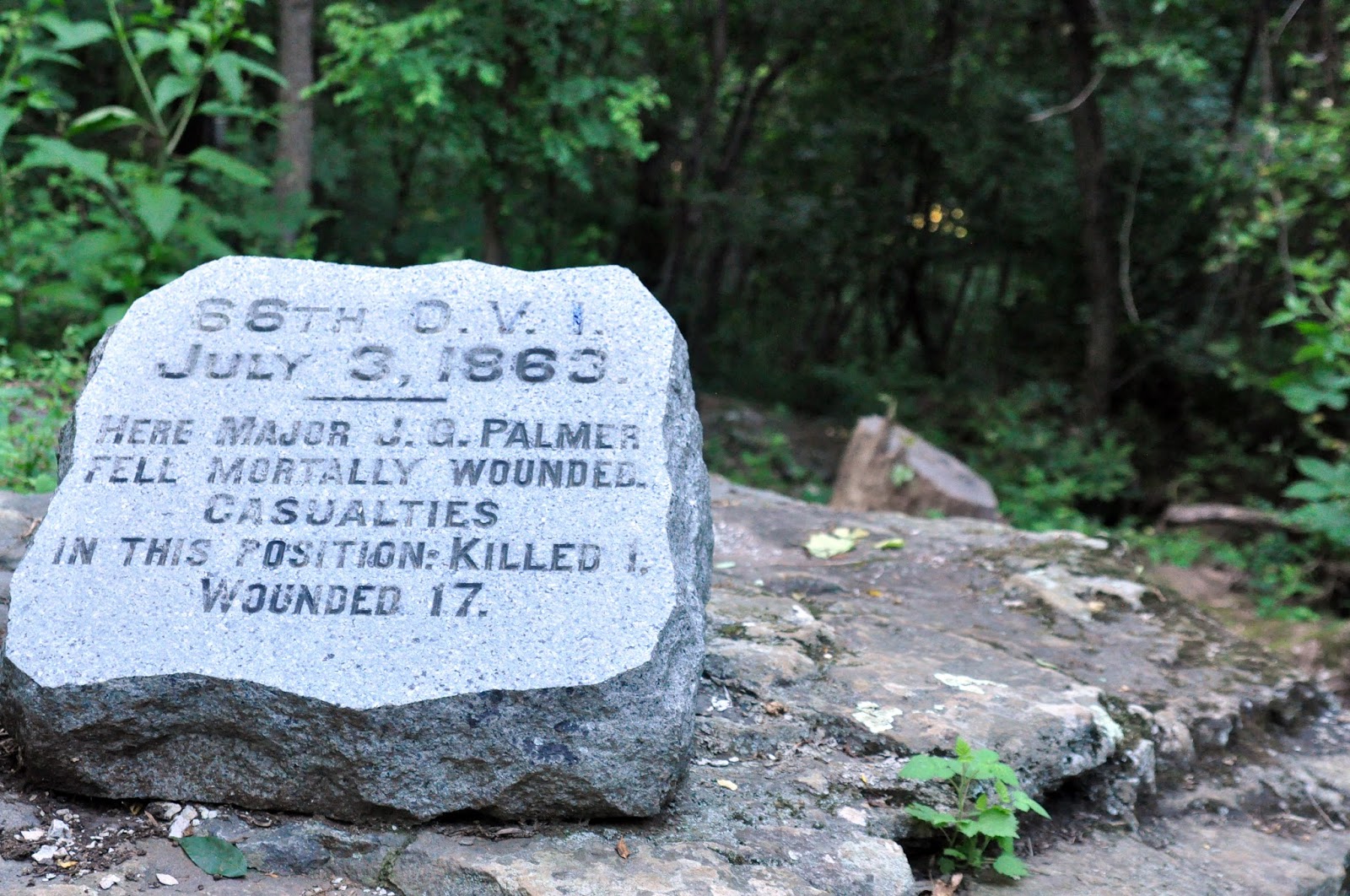
          Reluctantly, I walked through the poison ivy-laced unrelenting brush and started down the path on the rugged side of the steep and rocky hill I had photographed that day. Here is a photograph of a monument to an Ohio command that juts out from the surface of the steep and slippery hillside. This is the exact terrain I searched that difficult night, as I had photographed parts of the area earlier.


          No phone. No noise. Not a single luxury. Like Robinson Crusoe, as primitive as could be.


          Further down the hill I staggered, toward the next area I’d explored during the daylight hours, back when it was possible to avoid the dangerously aggressive and poison ivy-laden bushes on the nearly unapproachable rocks on the cliff-like hillside.


          Here is the next image I’d captured earlier in the day. Back when I could safely see where the next footstep ought to go. When the conditions were such that there was a reasonable opportunity to live through the experience.


          Here is an image of the path I walked down in the daylight hours and again in the pitch darkness of a moonless night. All the flashlights really did for me was to cast long shadows into the nothingness that was the dark of night.


          About this time, I realized that thousands of Confederate soldiers attacked the same area on the night of July2/3 in 1863. All they got out of it was a belly full of bullets. Their attack failed.


          My search failed as well. There was no cellphone on Culp’s Hill that night.


          I returned the next morning to look again but there was no sign of the escapee. I began to look back fondly to the short flight of the other cellphone back at the Alabama sports car track. At least I knew where to look for that phone.


          The Gettysburg story has a happy ending. After I headed off for the next day’s activity, Mrs. Leeway started calling the phone again and, Eureka! She got an answer. Turns out a group of teenaged French tourists found the phone and walked it to the nearest building they saw, which was a business that gives tourists bus rides around the Gettysburg area. When I returned to the hotel to have lunch with my sweetheart, she informed me of the development and we raced off to retrieve the wayward device.


          No way to determine where the kids found the phone, the bus company told us. The wonderful youths spoke just French and could only use sign language, of a sort, to report finding the phone. It was just luck that the manager of the company heard the phone ring when Mrs. Leeway called that morning. He moved around as a part of his job and wasn’t normally in position to hear it make noise. The battery was nearly exhausted.


          The moral to the story? There are two: The first is that French teenagers are both observant and kind. The second is that cellphones are a jumpy bunch. Try not to take offense.

          Thanks for reading.

Sunday, January 31, 2016

Mayflower: The story of a great rock and clash of peoples


          Just finished reading Nathaniel Philbrick’s book, Mayflower: A Story of Courage, Community and War. Interesting read.

          Not long ago, Philbrick’s book on Custer’s last stand joined our book shelves. That was also a good read.

          Mayflower probably ought to be renamed, “Fraught with Peril: Pilgrim Wars with Native Americans.” The book covers the Mayflower’s most famous voyage and follows the struggles of the passengers who stepped foot on Plymouth Rock in 1620 and then into history, but Philbrick’s primary research covers the wars fought by the European settlers against the Native Americans in the decades after the settlers arrived.

          King Philip’s War, the most severe of the Pilgrims’ campaigns, gets extended coverage.

          Philbrick gives readers a glimpse at familiar figures, such as Miles Standish. Philbrick links the Mayflower Compact with the later developments that were completed by the founding of the United States of America and he makes it clear that the Pilgrims, who fled Britain to North America in order to gain freedom to worship as they wished, still considered themselves Englishmen and Englishwomen.

          Interesting to note then that it was Englanders who began the slave trade on our continent when captured Native Americans were shipped off to various locations around the world to live as slaves. Yes, Britain ended legalized slavery before the United States did, but the Brits started it in the first place.

          Philbrick’s wonderful research also includes native sources.

          While the book is an interesting history about an amazing period, there is a minor criticism: The footnotes are in the back of the book. Your loyal blogger would rather read footnotes on the page upon which they are referred to instead of fishing around in back pages for the proper note.

          Near the end of the book there is a history of Plymouth Rock, considered here to be the greatest rock of all time. It is the bedrock of our society, the Rock of Ages and earthen anchor for our historic compass. Your loyal blogger has visited Plymouth Rock and considers it the most important rock in the history of our world, the site of the Pilgrims landing.

          More than a boulder, it is The Rock.

          Stepping over The Rock, the history in Mayflower is important and the writing is good enough to make Mayflower a worthwhile read.

          Hoping the same can be said for this blog, we thank you for reading.


Saturday, January 16, 2016

What Ifs at Gettysburg


  The What If question is one that keeps historians and sports fans busy.

          What if Oswald’s second shot missed President Kennedy, like the first shot did? Might the Secret Service agents have reacted in time to save the President? We’ll never know.

          What if Earl Morral saw the wide open Jimmy Orr at the end of the first half of Super Bowl III? Might the Colts have beaten the Jets? We’ll never know.

          What if yours truly won the lottery? We’ll never know, darn it.

          It’s hard enough to learn what did happen and your loyal blogger tends to avoid the What Ifs.

        
Looking from the Culp's Hill area toward Cemetery Ridge.
 
But if we play the What If game, let’s start at Gettysburg. The classic What Ifer from that battle is: What if Stonewall Jackson had been there? Jackson was dead by then, but what this question really means is what if the Confederates managed to capture the Culp’s Hill area on the first day of the battle. Another very obvious What If concerns JEB Stuart and his cavalry, which was absent when the fighting started at Gettysburg. What if Stuart was riding in concert with the main army? How much difference would Stuart’s force have made had it been a part of all three days of the fighting?

          The What Ifs above are probably the most popular among Gettysburg. They are debated frequently. In an effort to try something new, keep reading.


          Below are four What Ifs at Gettysburg that we should debate now.

         
First Shot marker.

          What If #1: What if R.E. Lee, the commanding general of the Army of Northern Virginia, had seen to it that his army’s marching line was compact prior to the opening of fighting on July 1, 1863?

          What If #2: What If Barksdale’s Mississippi brigade was properly supported during its attack on July 2, 1863?

          What If #3: What If Union general Dan Sickles had followed his orders pertaining to his alignment on July 2, 1863?

          What If #4: What if Lee or George Meade, commander of the Army of the Potomac could have selected the location of the battle?


          We’ll never know. But the reasons for the questions illustrate the points:


          #1: The march of the AoNV was strung out so far that some of Lee’s units were just getting to the field on July 3 and were exhausted when they got there, only to be thrown into a major attack. What if Lee had his command’s full strength in more reasonable proximity on the 1st?

       
Barksdale's attack met its first serious trouble about here. Look at the
Pennsylvania Memorial in the center of the image.
  
#2: Barksdale’s men came closer to turning the Union line than the more popular attack on Little Round Top. Barksdale actually penetrated the Union line and threatened to route George G. Meade’s defenders. What if the units assigned to follow and support Barksdale’s attack actually did so, rather than stop about halfway?

          #3: Sickles moved his defensive front roughly 1,000 yards forward of its assigned position along Cemetery Ridge before the fighting started on July 2. What if he did as ordered and stayed in place?

          #4: Old pal and fellow Civil War enthusiast Buck Weber throws down his gauntlets to ask this one. Lee came to the battlefield late in the first day and Meade arrived later still. Neither general did much choosing when it came to the location of the invasion showdown. Meade was ready to fight elsewhere, but he was not sure exactly where the AoNV was before fighting started on the 1st. Given better knowledge about where Lee approached from, might Meade have selected Gettysburg? With Stuart elsewhere, Lee didn’t know where the AoP was, exactly. Might he have pointed his strength at Gettysburg had he possessed that information?


          Obviously, we’ll never know the answers to any of these questions. But a What If blog is no good with, “We’ll never know,” for an answer. Your Loyal Blogger has Best Guess answers below.

          Got an answer? Try these for size:


          #1: The initial results might have been about the same, since the Confeds were generally successful at the start. But the first day might have ended differently, as Lee would have had fresh troops, or at least fresher troops, to send at Culp’s Hill and the Cemetery Hill/Ridge confluence. Our best guess is Meade would have fallen back to his prepared defensive line and invited Lee’s approach. We might then read occasionally about the Skirmish of Gettysburg.

 
Memorial to the Minnesota regiment that rushed to attack Barksdale's
Confederates on Cemetery Ridge.

          #2: Barksdale’s Mississippians were the most successful Confederates on July 2 at Gettysburg. Their charge was stopped by a small regiment of Minnesotans. Our best guess is had Barksdale’s support been active rather than quiet, the Union line would have been turned. Union reinforcements, such as those that ended up turning the tide on Little Round Top or fighting for the Wheatfield, would have been directed toward the Trostle Farm where Barksdale’s men were. That would made things different all over the battlefield. 

 
Hard to read. Dan Sickles was wounded here, near
the Trostle farm, not far from the Peach Orchard.

          #3: Sickles claimed for the remainder of his life that his decision to push his line forward turned the tide of the battle in favor of the AoP. Had he stayed in position, the Union defenders of Cemetery Ridge would have had a more cohesive defense but the attacking Confederates’ line would not have been disturbed by the bulge at the Peace Orchard. Union victory on the second day of the fighting might have been easier without Sickles’ movement.


          #4: Neither leader wanted to fight at Gettysburg, but that’s where the armies finally found each other. For Lee, the timing was poor because he was in the midst of trying to concentrate his army and did not have his full strength within favorable distance. We know Lee did not want a major engagement on July 1st because he told the officers leading his advance to avoid just such an occurrence.

Ooops.

          Meade’s army was sitting along the Pipe Creek Line and probably would have been satisfied if Lee’s men attacked that location. As it worked out Lee attacked anyway and Meade won his defensive battle.


          Do you have different thoughts? The best part about the What If game is that no thought is ever wrong. Know why that is? I don’t. In fact, I don’t think we’ll ever know.
          Thanks for reading.
On the rugged Culp's Hill, a small flag left as a tribute to the Ohio
regiment that fought so well with others in defense of the Union line.

Sunday, December 20, 2015

Question for your consideration


Monument to the 20th Maine at Little Round Top.
          The idea behind the topic of this issue of Speedyleeway is to spark debate. Your loyal blogger has an opinion on the question to be introduced and that opinion will be posted at a later date.

          There is no right and wrong here, only questions and opinions. Readers with opinions already formed are encouraged to render said opinions. Readers new to the question are urged to consider the background notes and then render your thoughts. Thoughts and opinions are welcome, so long as they are written politely. Political correctness is less important than plain, old fashioned good manners.

          Below is the background for the question, the question itself and a short list of pros and cons.

          Background: There is a small hill near the town of Gettysburg, Pennsylvania named Little Round Top. On July 2, 1863, the second day of the bloodiest battle of the American Civil War, the Confederate Army of Northern Virginia attacked along a broad front the defenses of the United States Army of the Potomac. The far left flank of the Union defense was on Little Round Top.

          The left-most Union regiment, the 20th Maine, endured a determined effort by the Confederate 15th Alabama regiment to crush the flank and take the high ground from the Union Army. To be sure, other Confederate regiments attacked other Union regiments at other locations on Little Round Top and Confederate regiments from Texas and Alabama actually succeeded in driving off the Union defenders in front of it. The timely arrival of reinforcements saved the day for the Union.

          For the purposes of this debate, all that matters is the fighting between the Maine regiment, commanded by Joshua L. Chamberlain, and the Alabamians led by William C. Oates.

          More complete information on the struggle is available in numerous books or websites, but we can sum the action up by saying the Confederates pressed the Maine defenders hard and failed to move Chamberlain’s men off the ground they defended.

          Chamberlain went on to make a career out of being the man who led the defense of the left flank at Gettysburg and eventually became the governor of Maine. Oates, a lawyer before the war, returned to the legal profession when the war ended but later went into politics and was elected the governor of Alabama.

          There is a memorial to the Maine regiment where those men so fiercely held their ground. While serving as Alabama’s governor, Oates wrote Governor Chamberlain of Maine to learn whether Chamberlain would fight against Oates’ desire to place a monument to his Alabama regiment on Little Round Top. Chamberlain did not oppose the idea until the old warriors got to discussing the location of the proposed Alabama memorial.

          Oates wanted to place the monument on the spot where, Oates said, his brother was killed. Oates described the desired spot to Chamberlain. Chamberlain was adamant that the Confederates did NOT penetrate the Union lines that far. The politicians agreed, the old soldiers did not. No monument to the 15th Alabama was ever erected on Little Round Top.

          Roughly 150 years later, your loyal blogger found two notes next to each other in the 20th Maine area of Little Round Top. They are pictured here and that brings us to the question.

Marker for position of left flank of the 20th Maine July 2, 1863.
          Question: Should there be a memorial of some sort to the 15th Alabama somewhere on or near Little Round Top?

Messages in favor of 15th Alabama monument on Little Round Top.
          Pro: The 20th Maine area is among the most visited locations of all the Civil War battlefield parks. Adding a marker for the 15th Alabama would enable better understanding for the fighting that was done there. Even Chamberlain was not against the idea, he was in disagreement with Oates over the location where Oates wanted the proposed marker to go. The politics of history should not determine the answer to this question.

          Con: It is too late now to do so because little would be served by putting the money or time into the effort. There are very few positions reached markers at Gettysburg for Confederate units, though there are a few. We do not know today where Oates wanted to locate the memorial to his regiment. Today we find the Confederate cause (the continuation of slavery) repellant, with good reason, and a monument to a Confederate unit would be the same as blessing the Confederate cause.

         
          Blogger’s answer: Your loyal blogger feels a position-reached marker or at least a plaque representing the pathway the 15th Alabama followed should have been erected decades ago, if for no other reason than to more clearly detail the history of the location. There are left and right flank markers for the Union regiments that indicate where the defenders were on Little Round Top but there are no indications of where each attacking Confederate regiment went up against those defenders.

          Given the popularity Little Round Top has among Gettysburg visitors (new and old), you would have expected that there would be more attention to detail about where each Confed regiment was. Look at it this way: Those Union regiments were fighting somebody. Why not delineate the attacking force?

          Having said that, it is certainly easy to spend someone else’s money. A marker for the 15th Alabama would cost money. The location would have to be determined, the type of marker/monument/statue would have to be decided and someone would have to pay to have the thing created, moved and erected. For this observer, the same thing would have to be done for the 48th Alabama, 4th Texas, 5th Texas, 4th Alabama and 47th Alabama because those regiments also attacked Little Round Top on July 2, 1863.
Right flank marker for the 16th Michigan on LRT.

The 48th Alabama and 4th Texas succeeded in dislodging the 16th Michigan from the Union right on Little Round Top. Only the timely arrival of the 140th New York saved the Union defenders from defeat. Certainly a position reached marker for those regiments would be in order, similar to the North Carolina marker pictured here near the wall on Cemetery Ridge.

However … it is too late now for the work to be done. The history of the location would be richly served, but historic accuracy has given way to political correctness in American society. The uproar over placing such markers would be damaging to the National Parks Service and this blogger cares too much about the good work the NPS does to risk the backlash that would certainly come.

With regret, the opinion here is that it will never happen.


Tuesday, December 8, 2015

Snowless in Ohio


          When we moved from California to the American Midwest, we knew the winter weather would be different. We prepared for the terrors of winter time in Northeastern Ohio and, for sure, the first three winters have been difficult.

          We’ve had our share of snow over the years since we moved. Snow is pretty, I’ll grant you that, but it brings ice with it and ice represents a chance to wreck your car or crack your skull without doing anything wrong.

          Nobody likes ice on the ground.

          But this winter has been different. We haven’t had a single flake of snow. Not one flake. We’ve had some grapple, which is sort of like snow. We’ve had frost on the roof and lawns. We even had a little rain last week.

          But snow? Nope. Nary a bit of it.

Above is a view of what the backyard should
look like this week. Instead, it looks like
the image below.


          Understand, we were really ready this year. We bought some of those orange sticks you see in the ground around construction sites and we put a few along the sides of our driveway and along the sidewalk in front of where we live. When the snow comes, we’ll know where the driveway and walkways end.

          If the snow comes, that is.

          You start getting confused when the snow is a no show. Mrs. Leeway assured me that we had not magically teleported back to California without warning. She used logic to prove herself correct.

          “This would be a 40 million dollar house,” she asserted. “This place isn’t worth that. You bought gas today for both cars and spent less than 40 bucks, right?”

          “Well, yeah.”

          “In California, we’d be paying an extra half a dollar a gallon. And do you see the state building a train set over perfectly good farm land around here? No, you don’t. I mean, when Jerry Brown says he’s going to railroad you, that man doesn’t fool around. But it isn’t happening here.”

          Solid points, all. With her evidence, Mrs. Leeway convinced me that we were still in Ohio. But that still did not explain where all the snow went.

          “The snow,” she explained, “is in Colorado. The really cold weather is in Canada. I saw it on the TV news.”

          “So they finally closed the Canadian border,” I guessed aloud. “Trump got his way.”

          “No. There is a high pressure system hanging over us and it is keeping the snow and really bad weather away.”

          Suddenly, I was triumphant. I had evidence that she was wrong, after all. Sensing victory, I charged forward with my verbal assault.

          “Hah!” I cried. “That’s what you always hear about in California. A high pressure system.”

          “No,” Mrs. Leeway said with strained patience. “In California, they have a system for getting high.”

          Darn it, she was right again.
          Thanks for reading.

Sunday, December 6, 2015

Liar Temptress Soldier Spy

Recently finished reading the book Liar, Temptress, Soldier, Spy, about four women during the Civil
War. This is an interesting look at the War from a very different perspective. I felt there are a few questions left unanswered but the author (Karen Abbott) doesn't guess at things. Important note: Do not expect to like all four subjects of this book. Two of them supported a cause our generation finds repellant. Still, the history itself is interesting and I recommend the book.

Friday, December 4, 2015

Winner speak


          Have you ever noticed that the first thing a winner does is try to make the loser look good?


          Think about it. A football coach is interviewed seconds after the game ends and one of the first comments the coach makes is, “That’s a heck of a football team we just beat.”


          The score was 34-0. The starters for the winning team did not play beyond the first half. Three managers played in the fourth quarter. The losing team was in the midst of a 15-game losing streak. Make it 16 games.


Lee: Great but lost
          But the winners always praise the losers. It goes beyond sports. Who is the best-known general of the American Civil War? Robert E. Lee. What side was he on? Well, that country doesn’t exist today.


          But who looks good? Seriously, if Lee was a genius, what does that make Ulysses Grant? Whatever the word is, it means Genius Beater.


          Go read a few books about the Second World War. Read about the German general, Erwin Rommel. Every third word about Rommel is either “genius” or “brilliant.”


Rommel blitzed the African continent, then lost it. Given command of the Normandy beaches, he managed to be away from the front when the allies launched the largest amphibious assault in history. Rommel was involved with the plot to kill Adolf Hitler (which is to Rommel’s credit), but even that didn’t work out.


Montgomery: Beat Rommel
Well, winners write military history. We won and we’ve written that Rommel was a brilliant genius.


The British general, Bernard Montgomery, thought Rommel was a genius. So did US commander George Patton. Montgomery beat Rommel in Africa and Patton was part of that theater. Thus, they beat the brilliant genius. So Montgomery and Patton must have REALLY been something, huh? (Not together, you understand. Patton and Montgomery were not friends.)


Watch the next US Presidential election. It does not matter who wins, they’ll say the same thing the night of their victory. Almost word-for-word, they’ll say, “I’ve just called (the loser) and congratulated (him/her) on conducting a tremendous campaign.” Translation? The winner is really saying, “We beat those losers easily but I want to look good, so I’ll pump them up.”


Watch a NASCAR race sometime. Frequently, after a close finish, the winner will say, “We probably had a fifth place car today, but we won.” In other words, the winning driver is saying, “I carried this sorry sled around for 500 miles and I’m a better driver than the rest of those guys.”


So keep an ear on what people are saying. Are they gracious winners? To be sure. But what are they really saying? Think about it: They might be saying, “Look at me!! I won!! I won!!”


That other blog is tremendous, too. Thanks for reading this one first.