Wednesday, January 3, 2018

2018 SPEEDY AWARDS


2018 SPEEDY AWARDS


          It is hard to believe that we have already reached that time again, but it is time for the annual SPEEDY Awards. All awards decisions are official immediately, unless I change my mind. In that case, Awards changes will go in this order: Revised Final, Final Revision, Final Final and Ultimate Final (pending review).

          With all of the above understood, we go to the Awards:


BOOK OF THE YEAR AWARD: That Bloody Hill: Hilliard’s Legion at Chickamauga. Published by McFarland, available online at the publisher’s website, as well as on Amazon and Barnes & Noble’s.


STAND UP AND FIGHT AWARD: To the heroic men and women who fought California’s terrible wildfires in December.


SO WHAT, IT ISN’T MY MONEY AWARD: To the California state legislature for adding an additional ten cents (or so) tax on every gallon of gasoline sold in the state. The new tax is supposed to help pay for repairs to roadways and other important infrastructure which, of course, was what the previously assessed taxes were supposed to pay for. The new tax actually will pay off the billions spent on a failed effort to build a massive train system that nobody in the state wanted.


COMMON SENSE AWARD: Discontinued due to a lack of nominees.


MEME OF THE YEAR AWARD: Dear Math, I am not a therapist. Go solve your own problems.


TURNAROUND AWARD: The Los Angeles Rams. Congrats to the coaching staff and players, they’ve gone from zero to hero.


WHAT THE HELL ARE YOU DOING HERE AWARD: The San Diego Chargers for moving out of a stadium in San Diego that the team’s ownership said wasn’t good enough for an NFL team in order to play home games on a soccer field with a seating capacity smaller than some high school stadiums.


NEEDS SUNBLOCK AWARD: Two winners for this award, a tie between the National Football League and NASCAR. Both entities are over-exposed on television and their ratings are under-performing.


SPORTS COLOR COMMENTATOR OF THE YEAR: Perhaps the most crowded field for any award we’ve ever issued. For the first time in SPEEDY AWARD history, we’ve split an award into three divisions in order to avoid making a decision.

Pro Football: Tony Romo, CBS Sports. Best NFL color man since the retirement of the great Hank Stram. Romo is the first commentator we have ever compared to Stram in a positive way.

College Football: Gary Danielson, CBS Sports. Has great enthusiasm for his job, sees the field as well as any commentator in the business, understands the ebb and flow of a game and always works well with the play-by-play man. Seamlessly transitioned from working with Vern Lundquist (a former SPEEDY winner) to SPEEDY nominee Brad Nessler.

High School Football: Jorge Grihalva, KXO Radio (El Centro, California) live streaming, Imperial High School football. His enthusiasm for the game and the kids playing it is obvious and he does an excellent job of keeping statistics as well. Joins Imperial play-by-play man Mickey Dale as SPEEDY winners.


TAPS AWARD: To my father. A proud WWII veteran and a great Dad.

Sunday, December 31, 2017

Thoughts for New Year's Eve

There will be times next year when life seems to be a confusing mess.


Every hurdle will seem too tall to leap over.


You'll want to hide your eyes.


But you can't just sit around and be sad.


You have to hang in there, darn it!


Look toward the future with hope ...


... and shake your fist (or rifle, whatever) at the past.


Sooner or later a pal will come bounding over the rocks ...


... and help you find the way.

HAPPY NEW YEAR, EVERYONE!

Wednesday, December 6, 2017

That Bloody Hill: Hilliard's Legion at Chickamauga


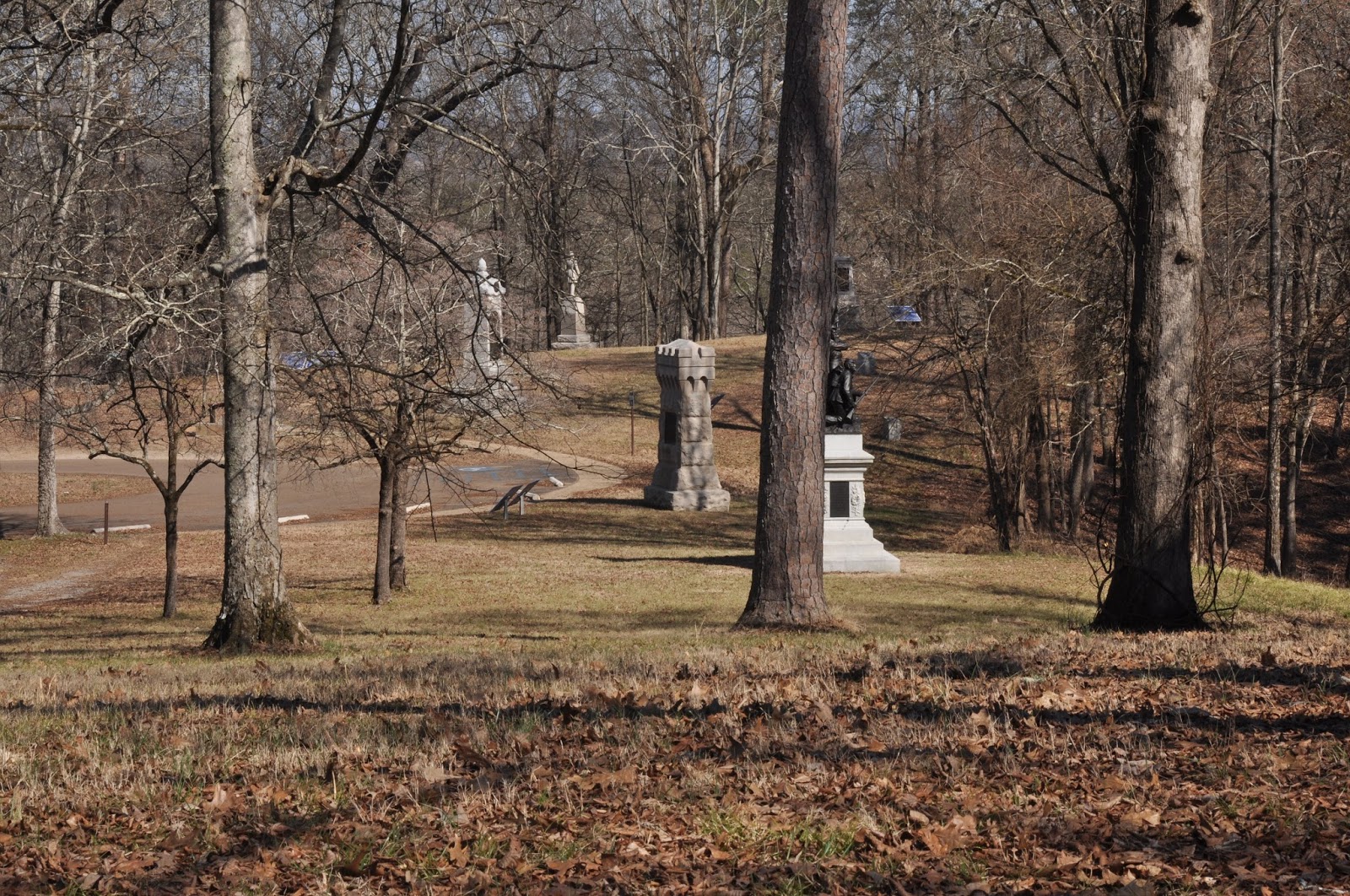
          Every time I visit the Chickamauga/Chattanooga National Military Park I end up in a specific area of the Park. I’ve studied that location. I’ve walked it. I’ve read reports and letters while walking it (which is sort of spooky) and I’ve photographed it.

          I have stood in various vantage points and tried to listen into the past to hear the rifle fire and blasting boom of artillery pieces. Above all, I have tried to listen to the human sounds, the shrieks and cries of the wounded. Those sounds are all around you if you listen hard enough. You can hear the history if you stand long enough on That Bloody Hill.

          The Federals defended hills one, two and three along Horseshoe Ridge during the afternoon and early evening hours of September 20, 1863 as the determined Confederates attacked. Eventually the Confederates pushed the heroic Union soldiers off the hill and away from the fighting. Some have termed the Battle of Chickamauga the Battle of Iron Hail and I shudder when I think of that description while visiting that area.

          I have written a book about those final hours of the three-day fight at Chickamauga. Specifically, my book follows a Confederate command that was part of a brigade commanded by Brigadier General Archibald Gracie through its movements during the battle. It took me thirteen years to complete the project and the result, which I completed the last work on this week, is named That Bloody Hill: Hilliard’s Legion at Chickamauga, will be published by McFarland early next year.
Looking at Hill 1 from Hill 2.

          During the research there were occasional moments of clarity but many more of confusion. At the suggestion of a professional historian I once taped together several sheets of legal-sized note paper and began writing a long timeline for the fighting on the Ridge and it was while performing that exercise that I began understanding how many events that happened in different places must have happened at the same time. Time estimates by the soldiers who fought along that Ridge vary greatly. In one important instance, the time variation was due to the similarities of two different events that seemed to be the same event. Go ahead, deal with that one for a while.

          My admiration for the soldiers on both sides of the fighting is complete. After more than a decade of trying to make sense of the whole thing, I told a friend that while I thought I knew what happened, I wasn’t sure how they did it.


          Chickamauga pitted the Confederate Army of Tennessee, reinforced by a portion of the Army of Northern Virginia, against the United States Army of the Cumberland. There are heroes on both sides of the story and there are goats, examples of good battlefield decisions by commanders and poor judgement, there is both praise and condemnation for the same soldier in many cases and there are personality conflicts galore. If the bloodletting along Horseshoe Ridge is a sad tale of killing, it is also a tale of failure and success, of valor and the vanquished and of victory and defeat.

          I hope you’ll buy a copy of my book when it is published. In fact, I suggest you buy vast quantities of copies. Anyone who does pick up a copy will hold in their hands the results of a journey. That journey included visits to archival collections, university libraries, homes of descendants of the armies, cemeteries and the battlefield. Lots of trips to the battlefield. I honestly don’t know how many trips I made to a local library so that I could use a microfilm reader to go through a collection of papers.

  
        Part of the book is a roster of the original members of Hilliard’s Legion. I will never again produce a book with a roster of names. My thumb, wrist and elbow were sore for months after I completed the roster, the victims of prolonged computer use.

          I spent so much time following those men through their military careers – in some instances through the end of their lives – that I felt as though I knew them. When I found a grave stone of a Legion soldier I frequently recognized the name even before I saw the regimental affiliation. It was always a solemn moment for me to reach the final resting place for a Chickamauga veteran, regardless of which side they served. My wife and I found two cemeteries in Ohio that had been on the grounds of POW camps during the war and there were Legion veterans in both cemeteries. Few experiences in life are as desolate as feeling your health fail while locked up as a prisoner of war.

          One location I visited was once a home for elderly Confederate veterans in Alabama. It is now called The Confederate Memorial Park and has two cemeteries. In one of them is a sign indicating that a tree had been planted in memory of a Legion member who immigrated to Brazil after the war. He was one of several former Legion men who became Confederados in Brazil. Now we’re talking about international history. As my long-time pal and fellow Civil War student Bucky Weber says, I’m not going down that rabbit hole, thank you very much.

          You can pre-order a copy of my book, That Bloody Hill: Hilliard’s Legion at Chickamauga, on the McFarland website, on Amazon or on the Barnes & Noble’s website. I hope you do.
          Thanks for reading.

Sunday, August 6, 2017

New perspectives of an old friend


General Warren on his rock. To the right of the general, in the distance, is the Pennsylvania Memorial, the
large structure with the dome. On the upper left of the image is the Codori barn.
              Very few locations at National Military Parks offer as many amazing photographic opportunities as Little Round Top at Gettysburg. The vistas from that little hill can be spell-binding for the viewer and offer gifts of every variety for photographers. If there is one commanding feature on LRT, it is the statue of federal general Gouverneur K. Warren.

The General with Cemetery Ridge in the distance.


          The general is so well posed that it is almost impossible to walk by without looking in the distance and imagining what he saw and did on July 2, 1863. Warren is a genuine hero of Gettysburg. His contribution to the Union victory in that battle can’t be overstated. If you should happen to have a camera in your hand it is almost impossible to ignore the general when you walk the hill.

          Even if you already have hundreds of images of the statue.


Your Loyal Blogger went looking for a new view of the general in June, new for this blog anyway. Other photogs have certainly captured these same angles at one time or another through the years, but they are new here. Different views of a tried and true subject can be a photographer’s joy.

          One challenge was to capture the general with both the Pennsylvania Memorial and the Codori barn in the same frame. It sounded easy, but so did

learning to drive a stick-shift. This collection started with the goal of collecting all three battlefield features in one image. The Memorial is to the right in the images, the barn is to the left.

          The other challenge was to keep the general’s interest while photographing features outside of his view. Well, you can’t win ‘em all.

          Also included in this collection is an image that does not include the general. Instead, the prominent feature is the monument to the 155th Pennsylvania Volunteers. This monument’s soldier is looking in the proper direction for the barn and the Pennsylvania Memorial because that unit fended off an attack from the direction of the Wheatfield, which he is looking at.
          YLB hopes you appreciate the effort involved here, even if the results might not be perfect. And thanks for reading.


Tuesday, July 25, 2017

My book will be published soon


          It is time to blog about my book. The urge to do so has been strong for months and some of the material for previous editions of this blog has stemmed from the research done for the book. I delayed writing about the book itself until now.


          My book, That Bloody Hill: Hilliard’s Legion at Chickamauga, is due to be published either late this year or next spring by McFarland, a leading independent publisher of academic and nonfiction books. It is an amazing experience to peruse the McFarland shelves and understand the range of topics covered. It will be an honor to see a copy of my book on one of those shelves someday.

          The decision to blog about the book was made easier when I recently saw the cover for the first time. To be blunt, I love the cover of my book. I will be very happy to arrange speaking engagements and bring copies of the book with me to sell because I think the book has a strong cover and good covers sell books.

          That Bloody Hill: Hilliard’s Legion at Chickamauga is the result of twelve long years of research, writing, photography and travel. It started out as a letter I sent to my father, along with a CD full of pictures, after my first visit to the battlefield at the Chickamauga/Chattanooga National Military Park. Then I thought that, with just a bit more research, I could write an article for one of the Civil War magazines I frequently read. When my magazine piece reached 10,000 words and was not near the end, I realized I needed to write a book.

          You can find the result on page 12 of the McFarland’s Fall catalog:


You can find it on Amazon:


          You can find it at Barnes & Noble:


          So long as you find it, that’s what matters.

          I came to learn that writing a book is a journey and you learn a great deal along the way, sometimes about your subject and sometimes about yourself. When the day comes that I put copies of my book in the hands of my family and friends, even if by mail, that journey will be complete.
          Thanks for reading.

Thursday, July 6, 2017

The Mystery Surrounding Amelia Earhart


          Amelia Earhart was an amazing woman. A pilot when few women flew, she was the first woman to cross the Atlantic Ocean by air when she went along as a passenger and then became the first woman to pilot her way across the ocean when she did it by herself. She was the first pilot of either gender to fly from Hawaii to California.

          She was a role model without setting out to achieve that status. She worked as a nurse during the first world war and later lectured at Purdue University. She wrote a book about her solo flight across the Atlantic and she was a poet. Her best-known poem, as far as I know, was titled Courage is the Price and is included below.

          Mary S. Lovell wrote, The Sound of Wings: The Life of Amelia Earhart. By far the best Earhart biography your loyal blogger has read.

          It is both unfair and true to say that, for all of her accomplishments, Amelia Earhart is best known today for her disappearance in July of 1937, nearly 80 years to the day before this writing. She was attempting to fly around the world at the equator and was down to the last three legs of the trip. Her third-to-last hop was supposed to be a 2,556-mile trip from New Guinea to Howland Island. Howland was little more than the size of a runway and there was a runway there for her to land on, refuel and take off again.

          She never got there. Earhart and her navigator, Fred Noonan, have been lost to the sands of time. Theories? We got your theories. Lots of theories about what happened at the end of the flight. Proof? There is none.

Clues? That sort of depends upon your idea of what a clue is. One writer said Earhart was alive and living in New Jersey in the 1970s. The writer put together the first letters from a chain of islands in the Pacific Ocean, made them spell the name of the woman’s husband and called that a clue. Not a clue at all, to logical people, but in a case where proof is drifting in the wind, well, a clue is a clue in the eye of the beholder. The writer sold a lot of books though.
Howland Island from the air.

Elgin Long and his wife, Marie, spent decades researching the disappearance. Their book, Amelia Earhart: The Mystery Solved, is a logical, fact-filled step toward solving the mystery. The Longs concluded that the final Earhart flight ended with a crash landing at sea. This is by far the most logical theory, held together by known facts. Elgin Long was himself a pilot and a veteran of long over water flights. The Long effort to find the Earhart plane at the bottom of the Pacific has yet to net the results hoped for.
My copy of Fred Goerner's book

CBS radio newsman Fred Goerner spent six years trying to solve the mystery and turned the effort into a literary journalism classic, The Search for Amelia Earhart. Goerner concluded that Earhart and Noonan crashed at sea and got picked up by a Japanese ship. They eventually died on the Japanese-held island, Saipan, Goerner wrote.

There have been other conclusions as well and, in the absence of creditable proof, they are possible if hard to believe. One adventurer has made numerous trips to an island in the Pacific, trying to prove Earhart and Noonan perished there.

Your loyal blogger has read many books about Earhart’s life and about her disappearance. Obviously, that is not the same as culling through official records, flying around the ocean and chopping through island vegetation, but if perspective means anything, perhaps it can be of service here.

A few important notes:

1.    A US Coast Guard cutter, the Itasca, was on station at Howland to assist with the flight.
No trespassing? Who are they kidding?

2.    Earhart never learned Morse Code and so she communicated with the Itasca via voice transmissions during her flight toward Howland. She only acknowledged hearing an Itasca transmission once during the flight, but the ship heard her in the final hours of the flight.

3.    Fred Noonan was an outstanding navigator. It was Noonan who set courses for the first Pan Am flying boats that flew across the Pacific.

4.    Howland Island was not exactly where Noonan and Earhart expected it to be. The chart they used to set navigation plans was slightly inaccurate with regards to Howland. Howland was about five miles away from the chart’s location.

5.    Earhart’s final radio transmissions were rated strength 5, the maximum, by Itasca radio operators. She estimated the plane was within 100 miles of Howland in one transmission. Your loyal blogger believes Earhart was correct.

6.    Earhart’s description of the cloudy weather near the end of the flight convinced the men aboard Itasca that the course to set for finding the lost plane was north and, when it became clear to those seasoned Coast Guard sailors that the plane was down, that’s where they headed.

7.    The days of Global Positioning Satellites were far in the future and even rudimentary versions of radar still weren’t off the drawing board. Earhart and Noonan had to try to find Howland with celestial navigation and sharp eyes. They didn’t.


It says here that Earhart and Noonan missed Howland to the north. For reasons

that have never been clear here, the plane was due to arrive shortly after sunrise at Howland. As they were flying west to east, Earhart and Noonan were flying directly into the sun’s morning glare. A different arrival time might have made finding landfall easier.

          Both Long and Goerner postulate in their books that Earhart and Noonan missed Howland slightly northwards. Goerner suggests that Earhart continued traveling east and was flying away from Howland when her fuel supply went dry. Long’s belief put the plane in a different spot when it splashed to earth but YLB sees little difference in the two ideas. The Earhart plane was likely north of the island.

          Then there is the long-standing matter of international politics. Japan was four and a half years away from bombing Pearl Harbor when Earhart and Noonan were lost and international tensions were high. Some people today believe Earhart’s flight was at least in part a spy mission to see what the strength of the Japanese military was on certain islands.

          Was Earhart on a spy mission? Did she fly over militarily sensitive, Japanese-held islands during the flight? Your loyal blogger doubts that theory because of the fuel needed to complete the flight. Her plane, a Lockheed Electra 10-E, was not capable of carrying enough fuel to complete a flight of that length, regardless of what island is suggested.

          Were Earhart and Noonan picked up after their watery landing by some sort of Japanese ship and taken prisoner? Did they die on Saipan?

          Goerner’s book makes it clear that he gathered witness reports in the early 1960s that two white fliers, a man and a woman, were in captivity on Saipan around the time Earhart and Noonan flew into the mists of fable and legend. If those reports are accurate – go ahead and disprove them, if you can – then it is very difficult to determine what two individuals they might have been other than the missing fliers.
The person sitting is conjectured to be Amelia Earhart sometime
after she disappeared. Standing at left is said to be Fred Noonan.

New conjecture has surfaced recently, centered around a photograph. A television documentary that will air Sunday purports to prove Earhart and Noonan are visible in an image taken on Jaluit Island after the end of the flight. The image has made it to the internet and, for this observer, it does not show Amelia Earhart and Fred Noonan.

The individual supposedly Earhart has the wrong haircut and seems to be wearing the wrong type of clothing. Further, the image is not clear enough to show the figure is even a female.  The figure that is supposedly Noonan isn’t clearly anybody. Perhaps the documentary will show better views of the image than has been available on the web. By the way, reports about the documentary indicate the researchers follow Goerner’s conclusions step-for-step.

Amelia Earhart and Fred Noonan crashed a sea after failing to find Howland Island in the middle of the Pacific Ocean in early July, 1937. They were somewhere north of Howland and may have been flying in a search pattern when their fuel supply was exhausted.

It is impossible to disprove the possibility that the two were captured by the Japanese and later died at the hands of their captors, but in the 80 years since the disappearance there has not been one single verifiable clue that proves the death on Saipan theory. A lot of people have searched and they’ve come home with zip.

Watch the show on Sunday and let’s all hope for new information that puts the mystery on the path toward solution, but it seems pretty clear that Earhart and Noonan died at sea. May God rest their souls.
Thanks for reading.


Courage is the price that life exacts for granting peace
The soul that knows it not knows no release from little things:
Knows not the livid loneliness of fear,
nor mountain heights where bitter joy can hear
The sound of wings
How can life grant us boon of living compensate
For gray ugliness and pregnant hate
Unless we dare the soul's dominion?
Each time we make a choice we pay
With courage to behold the restless day
And count it fair.

By Amelia Earhart

I watched the two-hour program on The History Channel last night and thought the researchers did a reasonably good job. Naturally, I found a few things to pick at. Still they did a good job of following Fred Goerner's research path and talked to some of the same witnesses Goerner found. I thought that, with the exception of the photograph in my blog above, the program was a credible effort.


Tuesday, May 16, 2017

Almost here: The 2017 Civil War Institute at Gettysburg College


          The 2017 Civil War Institute at Gettysburg College is less than a month away and Your Loyal Blogger is already fired up. Each year, hundreds of Civil War enthusiasts attend the five-day CWI to hear the leading experts of the day discuss the War and the era. It is an opportunity to learn history from the best experts in the field and then follow them into the fields to walk the pathways of legends.

          This year’s CWI is scheduled a bit earlier in June than usual, which means the annual wait between conferences was shorter than the norm, a wonderful note for YLB. It also means the wait for the 2018 conference will be more than a year and that will just suck.

  
Debating tour bus policy with long time pal Buck Weber.
       
The schedule for this year’s Institute is available at  http://www.gettysburg.edu/cwi/conference/schedule.dot and there is no reason for YLB to rewrite everything you can read there for yourself. There are seats available for this year’s conference, still, if you are interested.

          The highlight of this year’s visit for YLB figures to be the opportunity to listen to and then tour with Carol Reardon, a professor of history at Penn State. Reardon will lead a tour of the Antietam battlefield and YLB was lucky enough to be assigned to that tour. Reardon’s book, Pickett’s Charge In History & Memory is the best book on the War YLB has ever read, a stunner. If you happen to make your living in the public relations field, this book will interest you.

          Battlefield tours are a traditional part of the CWI. Each attendee has a chance to
Your Loyal Blogger with professor Susannah Ural at
last year's CWI after a tour that followed the steps of
General Hood's Texans during the battle.
tour twice during the conference. Typically, one tour is an all-day job at a battlefield other than Gettysburg. There is an introductory Gettysburg tour on the first day, which will be led by Arizona State’s Brooks Simpson this year. YLB has toured with Simpson during previous CWIs and he is a delightful guide. The second tour is usually a half-day deal at Gettysburg. The College is within sight of the Gettysburg battlefield, and played a role during the fighting. Attendees have a chance to select their favorite tours and the CWI team does a pretty good job of matching folks with their preferences.

          A day after walking Antietam with Reardon, YLB will follow another expert in the footsteps of the Armistead Brigade as it joined in the Confederate attack on July 3, 1863. Armistead’s men briefly pierced the Union line before the attack failed.

          For YLB, the lectures are the highlight of every CWI. A lot of notebooks have been filled in the six previous conferences. After the lectures, the CWI makes sure the lecturers are available to us attendees. We ask questions during the Q&A that follows each talk and there is typically a chance to chat with the speakers after they have left the stage. Since we all eat at the same place, there is also chance to dine with some of the speakers.

          Dr. Peter Carmichael, who prefers to be called Pete, runs the CWI and had a brainchild that really shows what the spirit of the CWI is all about. At dinner during a night or two each year, several lecturers conduct Dine Ins with small numbers of attendees to address specific subjects related to the War or the War era. Not all attendees can participate, as the numbers are held down to promote a more intimate gathering. YLB has been lucky enough to be selected for a few Dine Ins and the experience is tremendous. These are discussions, not lectures. Attendees talk, argue and learn from an expert. What could be better than that?

          It’s almost time to go. Hope to see you there.
          Thanks for reading.
There is no reason to rehash the story of the night YLB searched this
same area well after dark. The missing cellphone turned up the
next day at a different location. Some visits to Gettysburg remind
you that the losing general's name was, after all, Lee.