Friday, March 11, 2016

Kolb's Gems: Success after the Civil War


Reuben F. Kolb was a successful Alabama farmer when the Civil War broke out in 1861. Educated at the University of North Carolina at Chapel Hill (class of 1859), Kolb married the former Callie Cargile in 1860 and the union eventually produced three children.

          The coming of the war interrupted all Kolb’s farming. He served in Company B of the 1st Alabama Regiment immediately after the war commenced and then joined the Barbour Light Artillery in 1862. The Barbour bunch became part of Hilliard’s Legion later in 1862, joining the Fourth Battalion. The Fourth Battalion was supposed to be the artillery arm of the Legion, but Kolb’s men were split away from the Legion and put into another command.

          Kolb’s Battery served the Confederate Army until it surrendered at Augusta, Georgia in April of 1865. According to one website, Kolb’s Battery lost about 45 men to disease and about 70 more were killed or wounded in action.

          Kolb’s military career is just the tease to an interesting career in both agriculture and politics.

          Returning to his farm and family, Kolb started cultivating watermelons using the modern science of the time. His melons were so successful they were named Kolb’s Gems. The new strain of the fruit was hardier than the average melon. Kolb also experimented with peaches and pears.

          Eventually, Kolb played a leading role in the formation of Alabama’s state department of agriculture and industry. He was named a Trustee of what is now Auburn University. Kolb was elected President of the National Farmer’s Congress in 1887 and again in 1889.

          A populist, Kolb ran unsuccessfully for governor of Alabama three times. Failing to get the Democratic nomination one year, he mounted a third-party challenge and lost anyway. His gubernatorial campaigns were aimed at (and had the support of) Alabama’s poor workers and farmers. According to the Encyclopedia Alabama website, Kolb’s platform supported and was supported by African American farmers in Alabama.

          In 1911, Kolb was appointed the state’s Commissioner of Agriculture and he held that job until 1915.

Kolb died in 1918, having devoted his post-war career to educating fellow farmers on the most modern techniques and pushing the state away from its dependence on cotton. He gave the Alabama’s growers a louder voice at the state level and, as President of the National Farmers Congress, gave Alabama’s farmers a higher profile nationally.

Kolb’s story is not often told but he was an important man in his time and state. The bruising nature of post-war politics in the south denied him a serious chance at Alabama’s highest office, but his impact on the agriculture industry is undeniable. By pushing the scientific approach to farming, he made his mark.

And that’s important.
Thanks for reading.

Wednesday, March 9, 2016

International Women's Day, an appreciation


In honor of International Women’s Day, a few thoughts.

          Your Loyal Blogger has spent his life surrounded by amazing women. My mother, wife, sister and daughter are strong, intelligent and gifted people. It is an honor to know and love them all.

          That background developed the wisdom to understand a few things at an early age. To wit: Women are as strong as men but in different ways. Women are every bit as courageous as men. Women can be tough as nails.

          It says here that International Women’s Day should be a celebration of the pioneers of the cause of equality of the genders.

          This blogger’s favorite historic figure is Amelia Earhart, the famous pilot. The mystery surrounding her disappearance is fascinating but the story of her life is a study in tenacity. She broke barriers, set records and flew a lot of planes. She was the first woman to fly the Atlantic as a passenger, the first woman to solo the Atlantic and the first PILOT to solo from Hawaii to California.

          Without Earhart, we don’t have Sally Ride.

          And then there is drag racing champion Shirley Muldowney. Read this carefully: You have never (and you will never) met a more competitive human than Shirley Muldowney. She’s a three-time world champion. She came back from a catastrophic injury suffered in a racing accident and kept winning. Determined? Oh baby. Look at all the women racing and winning professionally in the National Hot Rod Association today and figure out for yourself where we might be without Muldowney.

          Janet Guthrie and Lyn St. James are best known for their careers in Indy car racing, but that’s the short story. Guthrie was the first woman to compete in the Indianapolis 500 and she raced at the highest levels of NASCAR as well. She was a successful sports car racer before that. St. James was the second woman to race at Indy and she is a 12-Hours of Sebring winner. St. James has continued to give back to the sport with her foundation. Without Guthrie and St. James, we don’t have Danica Patrick.

Heck, without Guthrie and St. James, we might not have Sarah Fisher. Fisher raced at Indy and now she’s a team owner in that form of racing.

A woman might well become our next President of the United States. Yours truly will not vote for her, our politics differ tremendously. In the post-election Hillarity, reporters will write millions of words about America’s first female President but the real political trailblazer will have been Jeannette Rankin of Montana, who became the first woman to be elected to Congress back in 1916. Interestingly, Rankin voted against the United States’ entry into the First World War and was the only member to vote against declaring War against Japan after the bombing of Pearl Harbor. Since we’re talking politics, Nellie Tayloe Ross (spelling is correct) became the first woman to be elected governor of a state when she was elected Governor of Wyoming in 1924.

Unlike a current presidential candidate, Condoleezza Rice was a successful Secretary of State and would have had this blogger’s vote had she run for President this time around.

You want a champion of a cause? How about Rosa Parks. Enough said.

Admittedly, society still has some distance to cover in the drive for gender equality. But we needed pioneering women to get us as far as we have come and it is the pioneers that we should remember today.


Thanks for reading.

Saturday, March 5, 2016

Meeting the Pro Football Researchers Association


          Six years ago, Your Loyal Blogger phoned home from a meeting of the Professional Football Researchers Association and said, “I have big news. It turns out I’m ignorant.”

          Mrs. Leeway said, “Sure, but what’s the big news?”

          As long as the family can remember, yours truly has made a study of the history of the professional game. I love it all and had a very balanced plan: The off-season was time for the study of the history of the game, the season was the time for watching the games. It made sense to me.


          But when my first PFRA meeting opened in 2010 and everyone introduced themselves, I discovered that I was in a room full of people who knew more about the history of pro football than I did. It was the first time since I was a small boy that this happened. I tried to rectify that situation by looking for people on the street who knew less about the game than me and suggesting that they join the PFRA immediately but, alas, that ploy failed. After all, we were in Canton, Ohio, home of the Pro Football Hall of Fame.

Well, it’s time to learn again. The Professional Football Researchers Association holds a general meeting every other year and the 2016 meeting is at Lambeau Field in Green Bay, Wisc. The meeting is scheduled for July 8-10.

          The venue offers PFRA members and other attendees the opportunity to find out what the PFRA is all about and tour what is probably the most storied NFL stadium still standing.

          You gotta love the list of speakers scheduled for us at Lambeau: The headliners are Zeke Bratkowski, the former Rams quarterback who backed up Bart Starr so well with the Packers during the glory years of Vince Lombardi’s reign, and Bob Long, a wide receiver during that same era.

          Since we’ll be in Green Bay and it will be near the start of the 50th anniversary of the 1966 Packers championship season, we’ll also hear from Packers historian Cliff Christl, Chuck Lane, the Packers PR man in 1966 and Bud Lea, a newspaperman who covered the team from 1954 through 1995.

          Several PFRA members will make presentations as well. Matt Foss will talk about the photography of former Packers photog Vernon Biever and John Maxymuk will discuss the building of the 1966 title team. I am especially interested to hear Rick Schabowski talk about the Milwaukee Badgers and other Wisconsin teams in the early years of the NFL.

          Massimo Foglio will talk about his recently-published book, Touchdown Europe.

          For Your Loyal Blogger, the best part of the meetings is spending time with so many like-minded fans of football history, real experts.

          The 2016 meeting costs $50 for members to attend and $100 for non-members (sneaky hint: Join for $35 and pay the $50, saving $15). There is a hotel in Green Bay that is offering a special rate for PFRA attendees and there is a shuttle each day from the hotel to the stadium.

          The PFRA is publishing a book this year about the 1966 Packers team that won the first Super Bowl. The book will be available for purchase at the meeting.

          You can read more about the PFRA at www.profootballresearchers.com. Hope to see you in Green Bay.

          Thanks for reading.


Thursday, February 11, 2016


          Your loyal blogger recently finished reading The Johnstown Flood by David McCullough.


As always in a McCullough book, the research is top notch and the writing is crisp.


But, another constant in a McCullough work, The Johnstown Flood also offers a glimpse into an era of history. How did people live in 1889? What new inventions were they enjoying? What did they eat and what clothes did they wear?


The answers to those questions and many, many others are answered in each McCullough effort.


The story of Johnstown was new for this reader. That makes reading the book all the more compelling. The author takes nothing for granted and carefully walks the reader through the event. You know the dam will fail and the flood is coming, but McCullough sets the stage so you can understand what was in the water’s path as it roared along its way.


This is a good book about history.


Thanks for reading.


Thursday, February 4, 2016

Life of a cellphone: Short bursts of freedom


          Normally, your loyal blogger challenges himself to write without using the word ‘I.’


          Most bloggers, it says here, have an ‘I’ problem because that seems to be their favorite word. Trying to be different while also exercising those writing muscles is a piece of work but today this blog will succumb to temptation in order to tell a story. It is a true story and the laugh is on, well, you know.


          First, the reader needs to understand the rocky nature of the relationship between this writer and his cellphone, specifically when the cellphone is dangerously positioned in a hip holster. The techno-gadget would be safer teetering on the edge of a cliff during an electrical storm. No cellphone is safe at my side.


          What that means is this: Those rascally phones love to leap away from me at the first opportunity. Once I was walking down some stairs at Barber Motorsports Park in Alabama, one of the finest racetracks in all of my experience. Just walking down the stairs, taking in the view as high-powered sports cars prepared to race, I was a happy observer.


          Sure, there was an elevator. But the elevator would have robbed me of the view and the sounds of racing that I so enjoy. Down the stairs I started and, wouldn’t you know it, my phone took a leap of faith off of my hip and down three stories through the center part of the stairwell.


          Remember the old Roadrunner cartoons where Wile E. Coyote takes an unintentional header off a cliff? We look down and wait until, splat, he lands and there is a puff of dust. That’s exactly what yours truly did; helplessly watch the $300 cellphone fail its flight test and crash to the ground. Smack, the parts shot in 360 different directions.


          The phone did not work again, even after I picked up all the pieces and jammed them together. The Humpty Dumpty of phones.


          So, you see, cellphones are elusive when around me.


          Please understand what can happen while reading the primary subject of this edition of the blog.


          Mrs. Leeway and I were in Gettysburg one June. We love our annual trek to the city, for different reasons. One evening I came back to the hotel with a huge load of images in my Nikon. It was time to download and I was very excited to see what I had accomplished with that session’s effort.


          I love Gettysburg, I love photography. I was a happy man, for a while.


          Then it was learned that my cellphone was no longer in its holster. It was not in the camera bag. It was not lost in the hotel elevator nor located in the hotel’s Lost and Found collection. The cellphone was not in our car, either.


          Mrs. Leeway’s calm reasoning processes combined with my intuition-based theorization and determined that there was only one place the cellphone could possibly be: Somewhere on the Gettysburg battlefield.


          Now, you need to understand that this reporter did not cover the entire twenty five square miles that make up the battlefield on that particular day. Actually, just one area had my attention between the last time the phone could be traced to my hand and the moment we discovered it was missing.


          Naturally, that location was Culp’s Hill, the location on the battlefield most closely resembling a three-story staircase. Steep, rocky slopes. Thick brush covering, well, steep and rocky slopes. Difficult to walk in daylight hours.


          By this time, it was nearly midnight. Darkness had fallen a few hours earlier that June night. Vision would be difficult, especially on the steep and rocky slopes that are covered with thick, unrelenting brush.


          After enlisting Mrs. Leeway to call begin calling the phone every ten minutes or so, I borrowed three flashlights from the hotel and plunged into the night searching for the escapee.


          Retraced my steps from earlier in the evening. Checked the artillery emplacements near the entrance to Culp’s Hill that I’d photographed and found no cellphones. Searched the area where I’d parked earlier to no avail. Finally, with no choices left, I drove into the Culp’s Hill area, all the way to the top and parked next to the observation tower.


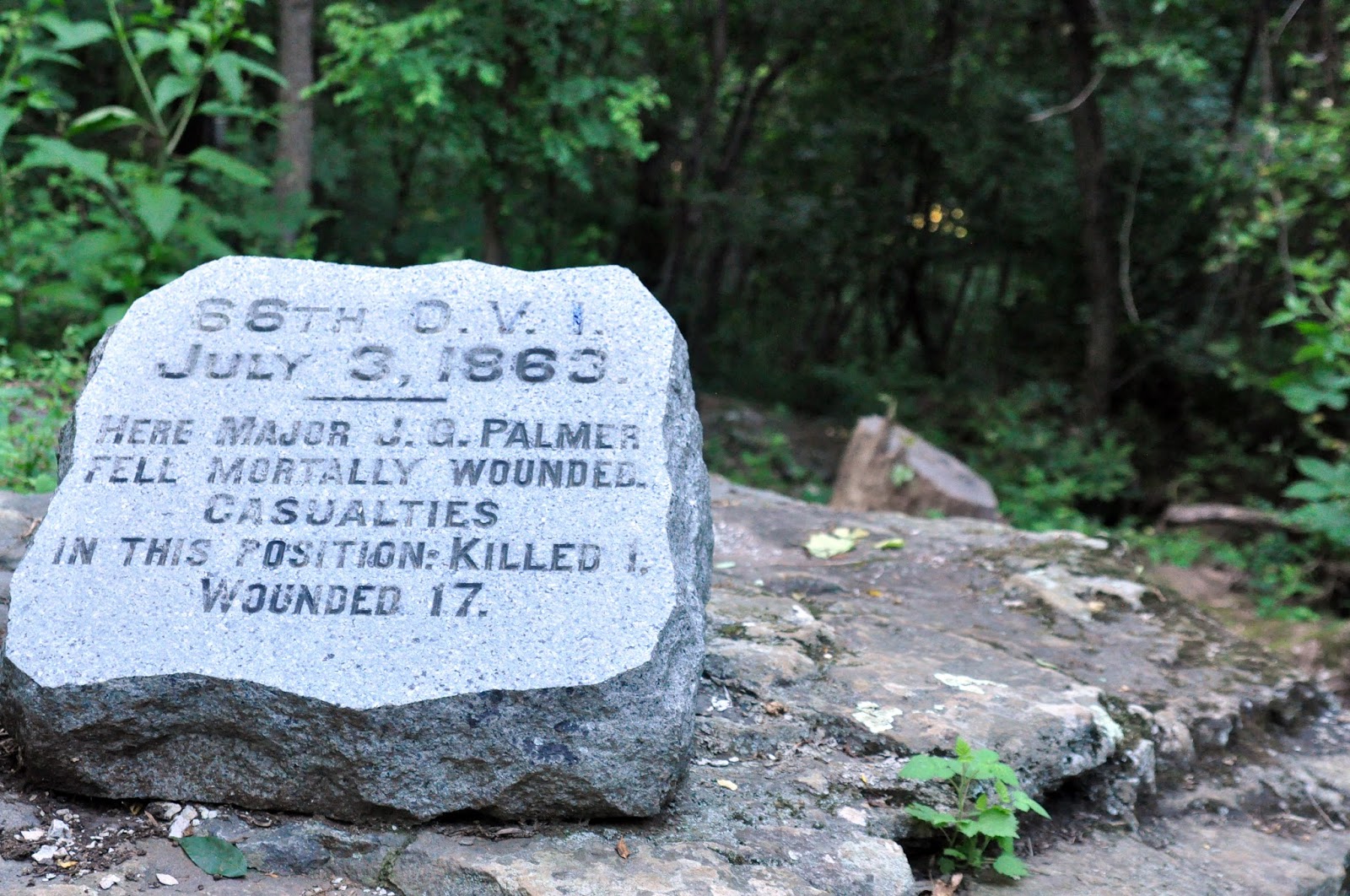
          Reluctantly, I walked through the poison ivy-laced unrelenting brush and started down the path on the rugged side of the steep and rocky hill I had photographed that day. Here is a photograph of a monument to an Ohio command that juts out from the surface of the steep and slippery hillside. This is the exact terrain I searched that difficult night, as I had photographed parts of the area earlier.


          No phone. No noise. Not a single luxury. Like Robinson Crusoe, as primitive as could be.


          Further down the hill I staggered, toward the next area I’d explored during the daylight hours, back when it was possible to avoid the dangerously aggressive and poison ivy-laden bushes on the nearly unapproachable rocks on the cliff-like hillside.


          Here is the next image I’d captured earlier in the day. Back when I could safely see where the next footstep ought to go. When the conditions were such that there was a reasonable opportunity to live through the experience.


          Here is an image of the path I walked down in the daylight hours and again in the pitch darkness of a moonless night. All the flashlights really did for me was to cast long shadows into the nothingness that was the dark of night.


          About this time, I realized that thousands of Confederate soldiers attacked the same area on the night of July2/3 in 1863. All they got out of it was a belly full of bullets. Their attack failed.


          My search failed as well. There was no cellphone on Culp’s Hill that night.


          I returned the next morning to look again but there was no sign of the escapee. I began to look back fondly to the short flight of the other cellphone back at the Alabama sports car track. At least I knew where to look for that phone.


          The Gettysburg story has a happy ending. After I headed off for the next day’s activity, Mrs. Leeway started calling the phone again and, Eureka! She got an answer. Turns out a group of teenaged French tourists found the phone and walked it to the nearest building they saw, which was a business that gives tourists bus rides around the Gettysburg area. When I returned to the hotel to have lunch with my sweetheart, she informed me of the development and we raced off to retrieve the wayward device.


          No way to determine where the kids found the phone, the bus company told us. The wonderful youths spoke just French and could only use sign language, of a sort, to report finding the phone. It was just luck that the manager of the company heard the phone ring when Mrs. Leeway called that morning. He moved around as a part of his job and wasn’t normally in position to hear it make noise. The battery was nearly exhausted.


          The moral to the story? There are two: The first is that French teenagers are both observant and kind. The second is that cellphones are a jumpy bunch. Try not to take offense.

          Thanks for reading.

Sunday, January 31, 2016

Mayflower: The story of a great rock and clash of peoples


          Just finished reading Nathaniel Philbrick’s book, Mayflower: A Story of Courage, Community and War. Interesting read.

          Not long ago, Philbrick’s book on Custer’s last stand joined our book shelves. That was also a good read.

          Mayflower probably ought to be renamed, “Fraught with Peril: Pilgrim Wars with Native Americans.” The book covers the Mayflower’s most famous voyage and follows the struggles of the passengers who stepped foot on Plymouth Rock in 1620 and then into history, but Philbrick’s primary research covers the wars fought by the European settlers against the Native Americans in the decades after the settlers arrived.

          King Philip’s War, the most severe of the Pilgrims’ campaigns, gets extended coverage.

          Philbrick gives readers a glimpse at familiar figures, such as Miles Standish. Philbrick links the Mayflower Compact with the later developments that were completed by the founding of the United States of America and he makes it clear that the Pilgrims, who fled Britain to North America in order to gain freedom to worship as they wished, still considered themselves Englishmen and Englishwomen.

          Interesting to note then that it was Englanders who began the slave trade on our continent when captured Native Americans were shipped off to various locations around the world to live as slaves. Yes, Britain ended legalized slavery before the United States did, but the Brits started it in the first place.

          Philbrick’s wonderful research also includes native sources.

          While the book is an interesting history about an amazing period, there is a minor criticism: The footnotes are in the back of the book. Your loyal blogger would rather read footnotes on the page upon which they are referred to instead of fishing around in back pages for the proper note.

          Near the end of the book there is a history of Plymouth Rock, considered here to be the greatest rock of all time. It is the bedrock of our society, the Rock of Ages and earthen anchor for our historic compass. Your loyal blogger has visited Plymouth Rock and considers it the most important rock in the history of our world, the site of the Pilgrims landing.

          More than a boulder, it is The Rock.

          Stepping over The Rock, the history in Mayflower is important and the writing is good enough to make Mayflower a worthwhile read.

          Hoping the same can be said for this blog, we thank you for reading.


Saturday, January 16, 2016

What Ifs at Gettysburg


  The What If question is one that keeps historians and sports fans busy.

          What if Oswald’s second shot missed President Kennedy, like the first shot did? Might the Secret Service agents have reacted in time to save the President? We’ll never know.

          What if Earl Morral saw the wide open Jimmy Orr at the end of the first half of Super Bowl III? Might the Colts have beaten the Jets? We’ll never know.

          What if yours truly won the lottery? We’ll never know, darn it.

          It’s hard enough to learn what did happen and your loyal blogger tends to avoid the What Ifs.

        
Looking from the Culp's Hill area toward Cemetery Ridge.
 
But if we play the What If game, let’s start at Gettysburg. The classic What Ifer from that battle is: What if Stonewall Jackson had been there? Jackson was dead by then, but what this question really means is what if the Confederates managed to capture the Culp’s Hill area on the first day of the battle. Another very obvious What If concerns JEB Stuart and his cavalry, which was absent when the fighting started at Gettysburg. What if Stuart was riding in concert with the main army? How much difference would Stuart’s force have made had it been a part of all three days of the fighting?

          The What Ifs above are probably the most popular among Gettysburg. They are debated frequently. In an effort to try something new, keep reading.


          Below are four What Ifs at Gettysburg that we should debate now.

         
First Shot marker.

          What If #1: What if R.E. Lee, the commanding general of the Army of Northern Virginia, had seen to it that his army’s marching line was compact prior to the opening of fighting on July 1, 1863?

          What If #2: What If Barksdale’s Mississippi brigade was properly supported during its attack on July 2, 1863?

          What If #3: What If Union general Dan Sickles had followed his orders pertaining to his alignment on July 2, 1863?

          What If #4: What if Lee or George Meade, commander of the Army of the Potomac could have selected the location of the battle?


          We’ll never know. But the reasons for the questions illustrate the points:


          #1: The march of the AoNV was strung out so far that some of Lee’s units were just getting to the field on July 3 and were exhausted when they got there, only to be thrown into a major attack. What if Lee had his command’s full strength in more reasonable proximity on the 1st?

       
Barksdale's attack met its first serious trouble about here. Look at the
Pennsylvania Memorial in the center of the image.
  
#2: Barksdale’s men came closer to turning the Union line than the more popular attack on Little Round Top. Barksdale actually penetrated the Union line and threatened to route George G. Meade’s defenders. What if the units assigned to follow and support Barksdale’s attack actually did so, rather than stop about halfway?

          #3: Sickles moved his defensive front roughly 1,000 yards forward of its assigned position along Cemetery Ridge before the fighting started on July 2. What if he did as ordered and stayed in place?

          #4: Old pal and fellow Civil War enthusiast Buck Weber throws down his gauntlets to ask this one. Lee came to the battlefield late in the first day and Meade arrived later still. Neither general did much choosing when it came to the location of the invasion showdown. Meade was ready to fight elsewhere, but he was not sure exactly where the AoNV was before fighting started on the 1st. Given better knowledge about where Lee approached from, might Meade have selected Gettysburg? With Stuart elsewhere, Lee didn’t know where the AoP was, exactly. Might he have pointed his strength at Gettysburg had he possessed that information?


          Obviously, we’ll never know the answers to any of these questions. But a What If blog is no good with, “We’ll never know,” for an answer. Your Loyal Blogger has Best Guess answers below.

          Got an answer? Try these for size:


          #1: The initial results might have been about the same, since the Confeds were generally successful at the start. But the first day might have ended differently, as Lee would have had fresh troops, or at least fresher troops, to send at Culp’s Hill and the Cemetery Hill/Ridge confluence. Our best guess is Meade would have fallen back to his prepared defensive line and invited Lee’s approach. We might then read occasionally about the Skirmish of Gettysburg.

 
Memorial to the Minnesota regiment that rushed to attack Barksdale's
Confederates on Cemetery Ridge.

          #2: Barksdale’s Mississippians were the most successful Confederates on July 2 at Gettysburg. Their charge was stopped by a small regiment of Minnesotans. Our best guess is had Barksdale’s support been active rather than quiet, the Union line would have been turned. Union reinforcements, such as those that ended up turning the tide on Little Round Top or fighting for the Wheatfield, would have been directed toward the Trostle Farm where Barksdale’s men were. That would made things different all over the battlefield. 

 
Hard to read. Dan Sickles was wounded here, near
the Trostle farm, not far from the Peach Orchard.

          #3: Sickles claimed for the remainder of his life that his decision to push his line forward turned the tide of the battle in favor of the AoP. Had he stayed in position, the Union defenders of Cemetery Ridge would have had a more cohesive defense but the attacking Confederates’ line would not have been disturbed by the bulge at the Peace Orchard. Union victory on the second day of the fighting might have been easier without Sickles’ movement.


          #4: Neither leader wanted to fight at Gettysburg, but that’s where the armies finally found each other. For Lee, the timing was poor because he was in the midst of trying to concentrate his army and did not have his full strength within favorable distance. We know Lee did not want a major engagement on July 1st because he told the officers leading his advance to avoid just such an occurrence.

Ooops.

          Meade’s army was sitting along the Pipe Creek Line and probably would have been satisfied if Lee’s men attacked that location. As it worked out Lee attacked anyway and Meade won his defensive battle.


          Do you have different thoughts? The best part about the What If game is that no thought is ever wrong. Know why that is? I don’t. In fact, I don’t think we’ll ever know.
          Thanks for reading.
On the rugged Culp's Hill, a small flag left as a tribute to the Ohio
regiment that fought so well with others in defense of the Union line.