Friday, July 6, 2018

Trip of a lifetime: The 2018 CWI at Gettysburg


          This year’s visit to the Civil War Institute at Gettysburg College was an exciting week in every possible way. It seems as if you read that same comment here annually, but this year’s CWI and the accompanying visits to the battlefield were richly rewarding.

On the shelves at CWI.


          Among the books on sale at the CWI this year was That Bloody Hill: Hilliard’s Legion at Chickamauga. That’s my book and it sold a few copies during the run of the Institute. I signed some autographs and got some unsolicited praise for the book. It was a wonderful moment to visit the supply of copies on the shelf (I did that several times a day) and it was really exciting to count one short every once in a while. I am indebted to everyone at the @CWI and to the @GettysburgCollege bookstore.

          Amy and I made this year’s trip to Gettysburg with our great friend Bucky Weber, the recently retired educator. Amy was forced to spend much of the trip with her leg on top of ice packs. She has an issue which has yet to resolve itself and, while I have been unable to fix the thing with my power drill or wrenches, Bucky and I were at least able to squire her around to her favorite eateries and ice cream shops. Even my daughter, Regan, recently married and happy as heck, made an appearance. Our stay was shortly after Father’s Day.

          The company was pretty darn good, you’d have to agree: My beautiful wife, a friend of long standing, my daughter (in the company of her dog) and 350 fellow Civil War enthusiasts. Oh, did I mention my book? It was there, too.


          When we weren’t busy at the CWI, Bucky and I roamed the Gettysburg battlefield. We spent a great deal of time in locations commonly associated with the first day of the battle, trying for a better understand of how things developed. One of the CWI tours led us to another first-day location and Buck and I returned to that spot a few days later to better photograph and understand the flow of the fighting and how the location fit in.

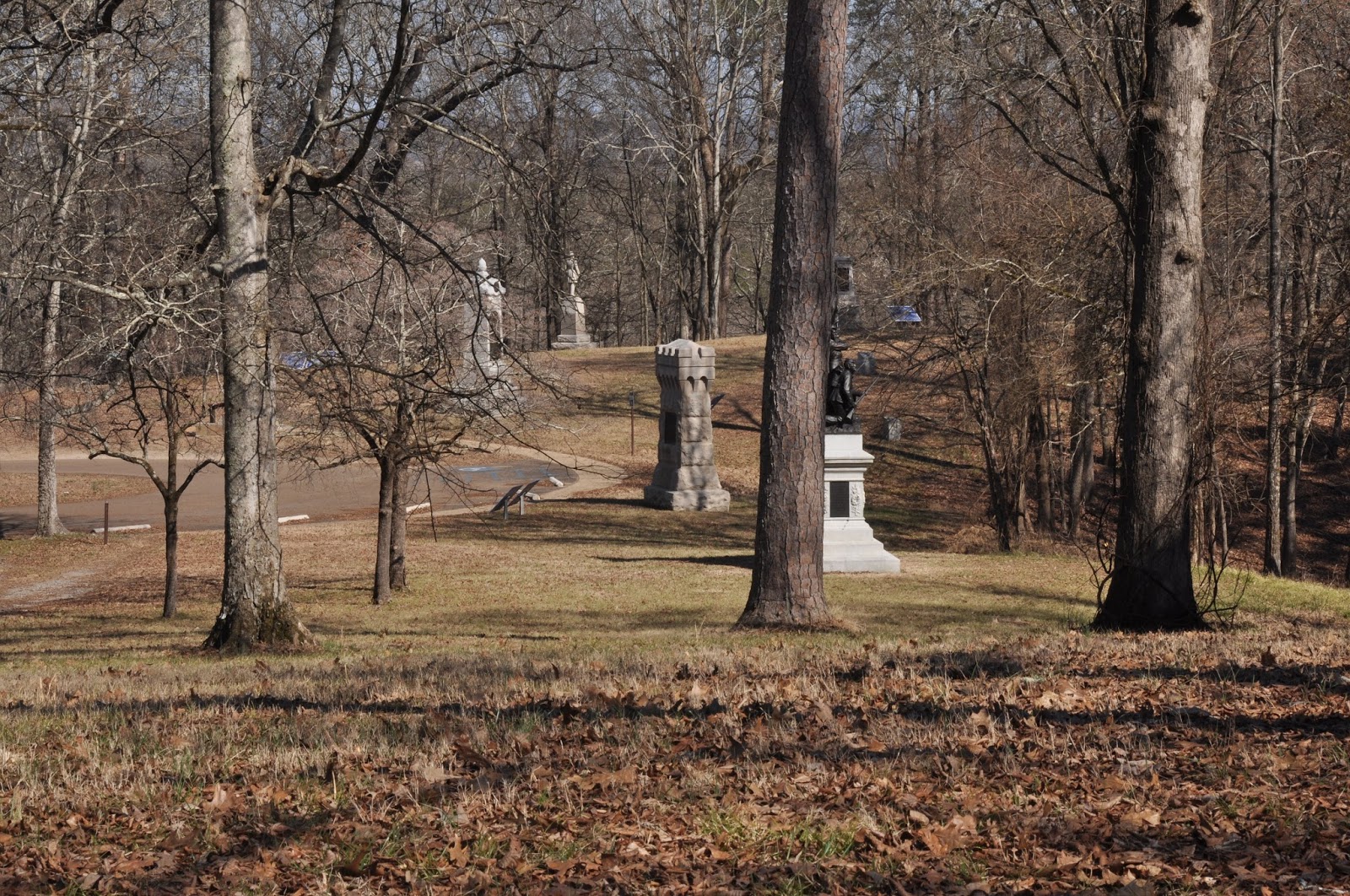
The top of the McPherson barn can be seen from at Iron Brigade
monument neat Willoughby Run.


          It is common for me to go home with a better understanding of some aspect of the battle. All the traipsing around and eyeing the vistas should lead to learning and this time it was a better appreciation for what has come to be called the Union fishhook defensive formation. Buck and I looked for Culp’s Hill from several perspectives and even climbed to the top of the Eisenhower Tower (which I had previously promised myself to never do again). By concentrating on Culp’s Hill, the fishhook became more evident to my eyes. Previously I knew about the fishhook, could have drawn it on a map and understood it. By concentrating on looking for Culp’s Hill from all around the battlefield, I came away with a better appreciation. I saw it more clearly, so to speak.

          Buck and I completed a walk we’d started two years earlier, down a pathway in the area where Barksdale’s Confederate attack sputtered to an end on the second day of fighting. We pretty much knew where the pathway might lead, but we had to be sure. Buck did not make it to Gettysburg last year and I did not want to complete the walk without him, so we did it this time.


          No trip to Gettysburg is complete without a visit to The Angle, the spot where Confederate General Armistead fell at the end of the third day. Your loyal blogger always spends sunset there because the photographic opportunities are usually very good. This time it was a little different. Buck and I looked for slightly different viewpoints because the sky was full of low clouds that blocked the setting sun from our view. Finally found something and had some fun. The results are here.

          Little Round Top attracts visitors of every sort almost 24 hours a day. It has a number of very nice photograph locations and the history is a huge draw. The fighting on LRT was no more important or desperate than the struggle on Culp’s Hill, but a very well-written and researched fictional account, The Killer Angels, popularized 
The monument to the 16th Michigan offers a view of The Devil's Den.

Joshua L. Chamberlain and his 20th Maine regiment for their brave and determined stand at LRT. Little Round Top has the added benefit that you can see much of the battlefield from its crest and you can get a good understanding of the ebb and flow of the fighting from its vantage points.

People come to see that little hill 24 hours a day. It is important to be very careful when walking there at night, but the people come anyway.

Hope you get a chance to see the place yourself someday. Until then please enjoy this selection from this year’s wanderings.
Thanks for reading.

Tuesday, June 12, 2018

Fathers Day without Dad


          I’ve been trying to avoid this, but the march of time eventually brought me face-to-face with the fact that this year will the first Fathers Day since we lost my Dad last year. Many of my friends have already been through this and I know that it is simply my turn. That does not make this easier.
Dad in uniform

          My sister had some programs printed for Dad’s funeral. On the back of the program was a brief bio I wrote and the headline was probably the best thing about the bio. I wrote that Dad was, “A damn good man from Alabam and a helluvan engineer.” Dad was all of that.
          My sister and I know all of Dad's stories and he had a lot of them. Suffice is to say that, in addition to being a great story teller, Dad was a kind, loving and supportive father. Dad loved his family and he especially loved his grandchildren. I learned a lot from him, obviously, but the lesson I learned from him that was the most important was also one I learned from my mother: Family first.
          Let me sum my Dad up with one story. I suffered a leg injury many years ago. I was going to drive myself about a hundred miles to see my surgeon in order to get the stitches removed but Dad wouldn’t hear of it. He flew out from the Midwest specifically to drive me to that appointment. Then, to make the trip tax deductible, he went to some kind of a meeting with someone who distributed books to schools in our area. Dad was a teacher by then and he was on a text book committee at his school. His meeting with the guy at the book distribution center made his trip to drive me to my appointment deductible. A few decades later I started working for myself and every damn trip I’ve taken since has included a meeting with someone who could make the trip deductible. I learned from the best.
Dad loved cookies. Never seemed to gain weight, either.

          My Dad was smart, probably the most intelligent man I ever met, and he was very widely read. Dad was an engineer by training but he knew something about everything. He could converse with anyone about anything. He and I shared an interest in sports – I made a living out of that interest – but the non-family topic we talked about the most was military history. Dad lived through the Great Depression and served in the United States Army during WWII, so he lived through many of the topics I read about. We talked about the war’s European Theater many times. Dad was not a great fan of the British general Field Marshal Sir Bernard L. Montgomery.
You know what? Neither am I.
Dad loved airplanes like I love sports. He was in the industry for many years and knew volumes about aircraft. All types of aircraft. Military, civilian, it didn’t matter. If it flew, Dad knew. I have watched the television show Air Disasters many times and several episodes have covered incidents Dad talked about. Too bad the show debuted when it did instead of earlier. The producers could have saved all of the time spent researching the crashes and just called Dad. If it flew and wrecked, Dad was on top of it.
Dad with most of his siblings.

We talked about politics a lot and we usually agreed. Some of Dad’s siblings were liberals and Dad was always happy to explain the error of their ways. Very happy to explain it.
I wish I’d been able to put a copy of my book in Dad’s hands before his health failed him. He was no longer reading near the end, but I’d like to have been able to give him a copy. There is family in that book and history. The words are mine, many of the photographs are mine and the book is about history. Dad would have liked that and I would have enjoyed hearing Dad tell someone, “My son wrote this book.”
I am going to miss calling my Dad on Fathers Day. Gonna miss calling him a lot. He was a great father and grandfather.
And he was a helluvan engineer.
Thanks for reading.

Wednesday, April 18, 2018

Review: Hood's Texas Brigade


          Just finished reading Susannah J. Ural’s Hood’s Texas Brigade: The Soldiers and Families of the Confederacy’s Most Celebrated Unit, an in-depth look at an impressive fighting group. This was an excellent read.

          Ural’s book takes the reader through a journey that visits the families and society that spawned and then supported Hood’s Brigade before, during and after the American Civil War. Using a variety of sources that generated a 29-page bibliography (21 pages of primary sources alone) at the back of the text, this book puts the reader face to face with the soldiers themselves.

          Ural tells the reader about the brigade’s loyalty to the Confederate cause and how that loyalty was really only tested when it was separated from the Army of Northern Virginia during the fall of 1863, fighting elsewhere for a few months. Despite the tremendous losses suffered on the battlefield (as well as the ones suffered to disease) and the difficulties experienced by loved ones back in Texas and Arkansas during the war, the Texas Brigade remained among the most successful Confederate Army fighting groups through the length of the war.

          Hood’s Texas Brigade is a different book from others of its type. Who were these men? Why did they remain loyal to a losing cause? Did their families at home support the war for as long a time as the soldiers did? Where was their greatest victory and what were their feelings after losing the war?
Professor Susannah J. Ural


          Ural argues that the Brigade continued to believe in the Confederacy’s chances for independence even after suffering through the loss at Gettysburg and the bloody victory at Chickamauga. How could that be true? Ural shows the evidence and tells the reader what it means.

          The answers make this book compelling because so much of what caused the Civil War in the first place and then made it last so long is evident in the story of the Texas Brigade. These men wanted to preserve the institution of slavery and when they didn’t, Ural’s work shows us what the Reconstruction period looked like in Texas. If the Brigade was an uncommonly capable military unit, it was still made up of normal, standard issue men of the time and this book illuminates their experiences.

          Your Loyal Blogger has now read three of Ural’s books (previously: Don’t Hurry Me Down to Hades: The Civil War in the Words of Those Who Lived It and The Harp and the Eagle: Irish-American Volunteers and the Union Army 1861-1865). Ural is a professor of history at the University of Southern Mississippi and is the codirector of the Dale Center for the Study of War and Society. She is a tenacious researcher and an outstanding speaker. She is a regular presenter at the Civil War Institute at Gettysburg College, where she is scheduled to speak again this summer.

          Hood’s Texas Brigade: The Soldiers and Families of the Confederacy’s Most Celebrated Unit is an excellent read about the Civil War and is highly recommended here.
          Thanks for reading.

Thursday, January 25, 2018

Captain N.T. Barnes


Research can be addictive. The more you learn, the more you want to know. Such was the case for Your Loyal Blogger during the research that resulted in my recently-published book, That Bloody Hill: Hilliard’s Legion at Chickamauga.


          Answers to questions generated more questions. The decision to generate a roster of the Legion’s members, for example, helped answer questions about who these soldiers were. It also stalled the completion of the book by several years. Different sources had different spellings of soldiers’ names. Did the different spellings represent the same soldier or two different men? It was hard to know and each name deserved the same amount of consideration.


          It was that need to know that led Mrs. Leeway and I to Johnson’s Island, a small clump of dirt about 150 yards off the coast of Sandusky, Ohio. The island was the home to a Civil War prison camp for Confederates and there is a small cemetery there for prisoners who did not survive the war. Unable to find a list of the interred online, we made the 90-minute trip from our home last fall to find the island and walk the rows of gravestones, hoping to find a member of the Legion.


          That is how we found Captain N.T. Barnes of the 10th Confederate Cavalry. His marker sits along one of the last rows we checked. He was a member of Hilliard’s Legion when the Legion was founded in 1862 in Alabama. Barnes was a member of the Legion’s Fifth Battalion, which was a cavalry battalion. Soon after the Legion was created, the Fifth Battalion was split off from its original organization and merged with a Georgia regiment to become the 10th Confederate Cavalry.


          Barnes enlisted as a Lieutenant and was promoted to Captain May 16, 1862. His luck turned on July 30, 1863 when he was captured near Big Hill, Kentucky. He was eventually transferred through two holding camps before he arrived at Johnson’s Island on August 4, 1863. Health is an uncertain thing in prison camps and Johnson’s Island sits in the cold waters of Lake Erie. Barnes died January 10, 1864.


          Born in Georgia, Barnes moved to Alabama before the coming of the war. He married Francis Lee Dent January 24, 1856 in Chambers, Alabama and they farmed. The Barnes farmed on about 60 acres of land whose cash value was listed at $300. They had farm machinery valued at $35. They owned three horses, six milch cows, 35 sheep and seven swine. The total value of the livestock came to $650. The farm produced wheat, rye, Indian corn and cotton.


          Cards on the table, Your Loyal Blogger has been unable to track down the census forms for 1860 that detail slave ownership. Barnes may or may not have been a slave holder.


          The Barnes appear to have had six children. The notes are a little complicated by the fact that two sets of daughters may have had the same first names.


          Finding Barnes’ marker on Johnson Island in north-central Ohio was a neat experience. It was a testimony to the idea that you can’t find something if you decide not to look for it. We had already found the graves of many Legion soldiers, several in the cemetery for another Ohio POW camp, this one in Columbus. A Legion soldier rests at Arlington National Cemetery in Virginia, several are buried at the site of a former home for aging former Confederates in Alabama. Others dot small and large cemeteries across the country.


          The key point here is that Civil War history can be found just about anywhere and I hope we keep looking as a society. We aren’t done learning yet, so keep your eyes open. You never know who might be around the next corner.


          Thanks for reading.

Wednesday, January 3, 2018

2018 SPEEDY AWARDS


2018 SPEEDY AWARDS


          It is hard to believe that we have already reached that time again, but it is time for the annual SPEEDY Awards. All awards decisions are official immediately, unless I change my mind. In that case, Awards changes will go in this order: Revised Final, Final Revision, Final Final and Ultimate Final (pending review).

          With all of the above understood, we go to the Awards:


BOOK OF THE YEAR AWARD: That Bloody Hill: Hilliard’s Legion at Chickamauga. Published by McFarland, available online at the publisher’s website, as well as on Amazon and Barnes & Noble’s.


STAND UP AND FIGHT AWARD: To the heroic men and women who fought California’s terrible wildfires in December.


SO WHAT, IT ISN’T MY MONEY AWARD: To the California state legislature for adding an additional ten cents (or so) tax on every gallon of gasoline sold in the state. The new tax is supposed to help pay for repairs to roadways and other important infrastructure which, of course, was what the previously assessed taxes were supposed to pay for. The new tax actually will pay off the billions spent on a failed effort to build a massive train system that nobody in the state wanted.


COMMON SENSE AWARD: Discontinued due to a lack of nominees.


MEME OF THE YEAR AWARD: Dear Math, I am not a therapist. Go solve your own problems.


TURNAROUND AWARD: The Los Angeles Rams. Congrats to the coaching staff and players, they’ve gone from zero to hero.


WHAT THE HELL ARE YOU DOING HERE AWARD: The San Diego Chargers for moving out of a stadium in San Diego that the team’s ownership said wasn’t good enough for an NFL team in order to play home games on a soccer field with a seating capacity smaller than some high school stadiums.


NEEDS SUNBLOCK AWARD: Two winners for this award, a tie between the National Football League and NASCAR. Both entities are over-exposed on television and their ratings are under-performing.


SPORTS COLOR COMMENTATOR OF THE YEAR: Perhaps the most crowded field for any award we’ve ever issued. For the first time in SPEEDY AWARD history, we’ve split an award into three divisions in order to avoid making a decision.

Pro Football: Tony Romo, CBS Sports. Best NFL color man since the retirement of the great Hank Stram. Romo is the first commentator we have ever compared to Stram in a positive way.

College Football: Gary Danielson, CBS Sports. Has great enthusiasm for his job, sees the field as well as any commentator in the business, understands the ebb and flow of a game and always works well with the play-by-play man. Seamlessly transitioned from working with Vern Lundquist (a former SPEEDY winner) to SPEEDY nominee Brad Nessler.

High School Football: Jorge Grihalva, KXO Radio (El Centro, California) live streaming, Imperial High School football. His enthusiasm for the game and the kids playing it is obvious and he does an excellent job of keeping statistics as well. Joins Imperial play-by-play man Mickey Dale as SPEEDY winners.


TAPS AWARD: To my father. A proud WWII veteran and a great Dad.

Sunday, December 31, 2017

Thoughts for New Year's Eve

There will be times next year when life seems to be a confusing mess.


Every hurdle will seem too tall to leap over.


You'll want to hide your eyes.


But you can't just sit around and be sad.


You have to hang in there, darn it!


Look toward the future with hope ...


... and shake your fist (or rifle, whatever) at the past.


Sooner or later a pal will come bounding over the rocks ...


... and help you find the way.

HAPPY NEW YEAR, EVERYONE!

Wednesday, December 6, 2017

That Bloody Hill: Hilliard's Legion at Chickamauga


          Every time I visit the Chickamauga/Chattanooga National Military Park I end up in a specific area of the Park. I’ve studied that location. I’ve walked it. I’ve read reports and letters while walking it (which is sort of spooky) and I’ve photographed it.

          I have stood in various vantage points and tried to listen into the past to hear the rifle fire and blasting boom of artillery pieces. Above all, I have tried to listen to the human sounds, the shrieks and cries of the wounded. Those sounds are all around you if you listen hard enough. You can hear the history if you stand long enough on That Bloody Hill.

          The Federals defended hills one, two and three along Horseshoe Ridge during the afternoon and early evening hours of September 20, 1863 as the determined Confederates attacked. Eventually the Confederates pushed the heroic Union soldiers off the hill and away from the fighting. Some have termed the Battle of Chickamauga the Battle of Iron Hail and I shudder when I think of that description while visiting that area.

          I have written a book about those final hours of the three-day fight at Chickamauga. Specifically, my book follows a Confederate command that was part of a brigade commanded by Brigadier General Archibald Gracie through its movements during the battle. It took me thirteen years to complete the project and the result, which I completed the last work on this week, is named That Bloody Hill: Hilliard’s Legion at Chickamauga, will be published by McFarland early next year.
Looking at Hill 1 from Hill 2.

          During the research there were occasional moments of clarity but many more of confusion. At the suggestion of a professional historian I once taped together several sheets of legal-sized note paper and began writing a long timeline for the fighting on the Ridge and it was while performing that exercise that I began understanding how many events that happened in different places must have happened at the same time. Time estimates by the soldiers who fought along that Ridge vary greatly. In one important instance, the time variation was due to the similarities of two different events that seemed to be the same event. Go ahead, deal with that one for a while.

          My admiration for the soldiers on both sides of the fighting is complete. After more than a decade of trying to make sense of the whole thing, I told a friend that while I thought I knew what happened, I wasn’t sure how they did it.


          Chickamauga pitted the Confederate Army of Tennessee, reinforced by a portion of the Army of Northern Virginia, against the United States Army of the Cumberland. There are heroes on both sides of the story and there are goats, examples of good battlefield decisions by commanders and poor judgement, there is both praise and condemnation for the same soldier in many cases and there are personality conflicts galore. If the bloodletting along Horseshoe Ridge is a sad tale of killing, it is also a tale of failure and success, of valor and the vanquished and of victory and defeat.

          I hope you’ll buy a copy of my book when it is published. In fact, I suggest you buy vast quantities of copies. Anyone who does pick up a copy will hold in their hands the results of a journey. That journey included visits to archival collections, university libraries, homes of descendants of the armies, cemeteries and the battlefield. Lots of trips to the battlefield. I honestly don’t know how many trips I made to a local library so that I could use a microfilm reader to go through a collection of papers.

  
        Part of the book is a roster of the original members of Hilliard’s Legion. I will never again produce a book with a roster of names. My thumb, wrist and elbow were sore for months after I completed the roster, the victims of prolonged computer use.

          I spent so much time following those men through their military careers – in some instances through the end of their lives – that I felt as though I knew them. When I found a grave stone of a Legion soldier I frequently recognized the name even before I saw the regimental affiliation. It was always a solemn moment for me to reach the final resting place for a Chickamauga veteran, regardless of which side they served. My wife and I found two cemeteries in Ohio that had been on the grounds of POW camps during the war and there were Legion veterans in both cemeteries. Few experiences in life are as desolate as feeling your health fail while locked up as a prisoner of war.

          One location I visited was once a home for elderly Confederate veterans in Alabama. It is now called The Confederate Memorial Park and has two cemeteries. In one of them is a sign indicating that a tree had been planted in memory of a Legion member who immigrated to Brazil after the war. He was one of several former Legion men who became Confederados in Brazil. Now we’re talking about international history. As my long-time pal and fellow Civil War student Bucky Weber says, I’m not going down that rabbit hole, thank you very much.

          You can pre-order a copy of my book, That Bloody Hill: Hilliard’s Legion at Chickamauga, on the McFarland website, on Amazon or on the Barnes & Noble’s website. I hope you do.
          Thanks for reading.